




Why I Believe Carbon Credits Are a False Solution — And Possibly One of the Greatest Climate Illusions
I am not one to criticize solutions lightly. None of us has all the answers, and the climate crisis is too serious for ego battles. I understand that global negotiations are complicated, that countries are sovereign, and that institutions like the UNFCCC often work with “the least bad option” in a capitalist world.
But after attending multiple carbon market engagements, I keep returning to one simple question:
Does the mathematics of carbon credits actually reduce carbon in the atmosphere?
Because climate change is not political theory.
It is physics, chemistry and numbers. And numbers do not lie.
The Core Problem: Too Much Carbon in the Atmosphere
Climate change is driven by excess greenhouse gases, especially CO₂.
So the real global equation is:
Carbon in atmosphere = Total emissions − Total removals
If emissions stay high, the atmosphere keeps filling — like a bathtub with the tap still running.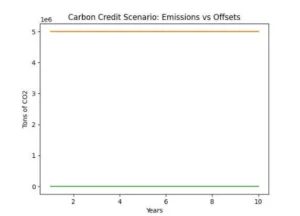
So logically, the main solution should be:
Reduce emissions at the source. Not just shift responsibility on paper.
THE SIMPLE MATH
Scenario 1 — Carbon Credits Model (Offsetting)
- A company emits 5 million tons of CO₂ every year
- Instead of reducing pollution, they “buy” a forest that absorbs 5 million tons
- On paper:
5,000,000 (emitted)−5,000,000 (offset) = 0
So the books say “Net Zero.” But here’s the catch:
- That forest was already there
- It was already absorbing that carbon
- No new carbon is removed
- Pollution at the source never drops
So physically in the atmosphere:
➡ Carbon entering air each year = 5 million tons
➡ Carbon reduction at source = ZERO
This is what the first chart shows:
A flat line. Emissions never go down.
Result after 10 years:
5,000,000×10=50,000,000 tons still released
The atmosphere doesn’t read financial reports. It reads physics.
Scenario 2 — Real Emission Reduction (Cutting the Source)
Now compare that to actual reduction:
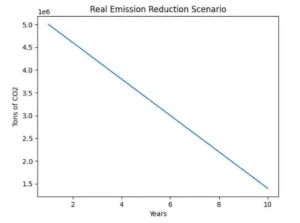
If emissions drop by 400,000 tons every year, then:
Year | Emissions |
1 | 5,000,000 |
5 | 3,400,000 |
10 | 1,400,000 |
That’s a 72% reduction in 10 years.
The second graph slopes downward, because carbon entering the atmosphere is actually decreasing.
WHY THE MATH OF CARBON CREDITS FAILS (IN YOUR ARGUMENT)
My logic is:
Offsets = Accounting balance
Reductions = Physical balance
Carbon credits balance money books, not carbon physics. So let’s do a little mathematics….
If:
E=Emissions A=Absorption already happening N=New absorption created
Carbon markets often do:
E−A=0
But since A already existed, the real equation should be:
E−N
And if N = 0, then:
E−0=E
Which means nothing changed in the atmosphere. Emissions stayed the same. You only moved money around.
For Example
If a house is on fire because gas is leaking:
- The first action is to shut off the gas
- Not to pour more water while the gas continues flowing
Carbon credits often do the opposite:
They allow the “gas flow” (emissions) to continue; while we argue about how much “water” (offsets) we can add.
Now Let’s Do the Simple Mathematics
Let us explain Scenario 1 again
- Company A emits 5,000,000 tons of CO₂ per year
- Instead of reducing emissions, it buys carbon credits from a forest project
That forest is said to absorb:
5,000,000 tons of CO₂
On paper, we say:
5M emissions − 5M offsets = Net zero
Looks beautiful. But here’s where the math breaks.
Problem 1: The Forest Was Already There (No New Removal)
Let’s say that forest has existed for 200 years.
Before Company A came:
- The forest was already absorbing 5M tons
- The global carbon system had already “counted” that
So the real global situation before credits:
Source | Carbon Flow |
Company A | +5M tons |
Forest | −5M tons |
Net effect | 0 (in theory) |
Now Company A buys the forest as a credit.
But the forest does not suddenly absorb extra carbon.
It still absorbs: −5M tons (same as before)
But now:
Source | Carbon Flow |
Company A | +5M tons (still emitting) |
Forest | −5M tons (same old forest) |
Atmospheric reality | Still 0 from forest, +5M new emissions happening |
The credit did not remove additional carbon.
It just reassigned ownership of something that was already happening.
This is called lack of additionality, and mathematically, it means:
Real net change = +5M tons. Not zero.
Problem 2: Carbon Stays, But Credits Move
CO₂ stays in the atmosphere for hundreds of years.
But credits are:
- Financial instruments
- Traded yearly
- Based on projections
You are using temporary biological storage (trees) to cancel permanent fossil carbon released from underground.
That’s like saying:
“I will store your garbage in my backyard for now, so you can keep producing it.”
The physics are not equal.
Problem 3: Incentive Structure (Capitalism Enters)
Let’s say:
- Cost to reduce emissions = $50 per ton
- Cost to buy credit = $10 per ton
A company emitting 5M tons will do:
5M × $10 = $50M in credits
Instead of:
5M × $50 = $250M to reduce emissions
So what does the market encourage?
Keep polluting. Just pay cheaper.
And companies simply pass the cost to consumers.
So:
- Pollution continues
- Prices rise
- Atmosphere still fills
Mathematically:
Emissions stay high because the cheaper option is to offset, not to reduce
Problem 4: The Global Total Still Rises
Let’s zoom out.
If:
- 1,000 companies each emit 5M tons
- They all “offset” using existing forests
Global fossil emissions = 5 billion tons
Forest absorption = the same forests we already had
So:
We are not subtracting new carbon
We are just moving numbers in spreadsheets
Atmosphere math:
Old forest absorption = constant
New fossil emissions = increasing
So atmospheric CO₂ still goes up.
Why This Feels Like a Climate Illusion
Carbon markets turn carbon into a commodity, not a problem to eliminate.
We are trying to financially balance a physical imbalance.
But nature does not recognize:
- Certificates
- Markets
- Trading platforms
Nature recognizes only:
How many molecules of CO₂ are in the air.
What Should We Be Doing Instead?
I believe the real shift should be:
🔹 Stop commercializing carbon
🔹 Move money away from fossil carbon systems
🔹 Invest massively in:
- Renewable energy
- Storage technology
- Electrification
- Efficiency
- Regenerative land use
Instead of asking:
“How do we offset emissions?”
We should ask:
“How do we redesign the economy so emissions don’t happen?”
Final Thought
Carbon credits may comfort governments and corporations.
They may create financial flows.
But if the math does not reduce actual atmospheric carbon, then we are not solving climate change; we are managing guilt.
And the atmosphere does not respond to guilt.
It responds to physics.